

The internet ceases to feel like a metaphor the first time you enter a real data center’s “cold aisle.” Your throat will get dry from the sharpness of the air. A constant, mechanical wind is pushed by fans. In tiny, uncaring rhythms, LEDs blink. Behind the locked cabinets, behind the sleek, contemporary branding about AI and the cloud, there’s an older sound: racks of spinning disks performing the unglamorous task of preventing the evaporation of everyone’s forgotten corporate files, logs, backups, security footage, and photos.
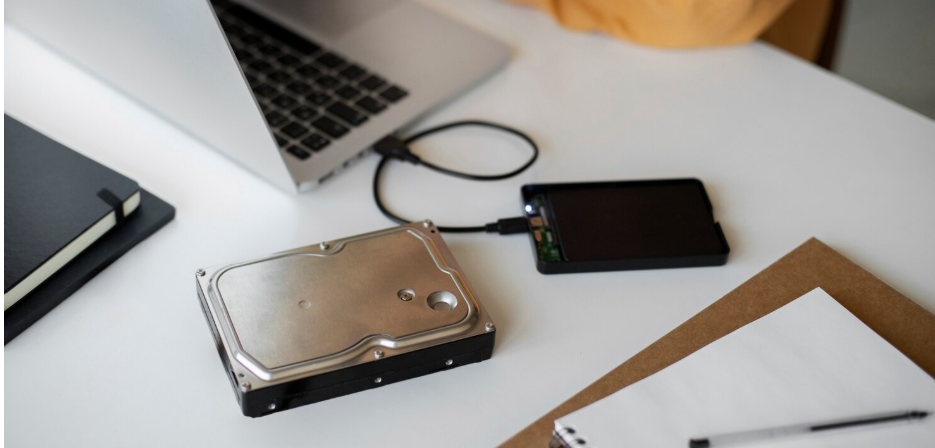
SSDs seem to have already won because they are clearly superior in areas that people can touch, such as phones, laptops, and game consoles. Everything boots up right away. Nothing seems to click. However, the internet serves as more than just a boot drive. The majority of it is a warehouse. Additionally, unlike consumers, warehouses are obsessed with unit economics. The same argument is still frequently brought up in industry discussions about hyperscale storage: the most affordable, dependable terabyte usually outperforms the fastest terabyte when data is being stored by the exabyte.
| Item | Details |
|---|---|
| Topic | Why hard disk drives (HDDs) still store most internet data even as solid-state drives (SSDs) dominate consumer devices |
| Where HDDs still win | Hyperscale and enterprise data centers storing “warm” and “cold” data in bulk (Seagate) |
| Why it matters | Storage decisions are driven by total cost of ownership (TCO), density, power per TB, and replacement cycles (Seagate) |
| A commonly cited split | Industry sources often put cloud exabyte storage heavily on HDDs (with SSDs concentrated near compute for latency-sensitive work) (Seagate) |
| Capacity trajectory (illustrative) | HDD roadmaps keep pushing areal density via technologies like HAMR / related approaches, though timelines shift (TechRadar) |
| One authentic reference link | Seagate’s “Rethink Data” hub (report + background): https://www.seagate.com/our-story/rethink-data/ (Seagate) |
The storage medium that still makes “keep it all” financially feasible is hard drives. That’s an accountant’s claim, not a romantic one. In contrast to SSDs, which are deployed where latency and transaction rates truly pay for themselves, vendor materials and industry coverage frequently describe cloud capacity still relying heavily on HDDs. Everyone has an incentive to frame the split in their favor, so it’s possible that the precise percentages are used as marketing gimmicks. However, the general trend is clear: disk absorbs the majority, while flash sits closer to compute.
Observe the behavior of contemporary workloads, and the rationale becomes less philosophical. Many internet resources aren’t being “used,” at least not in the manner that an application uses a database. It is being kept. Despite writing all day, security cameras are hardly ever reviewed. Mountains of intermediate data are produced by AI pipelines, which then store the outputs and logs pertaining to them. Businesses refer to “data lakes” in the same way that earlier generations did with filing cabinets, except that the cabinets never stop reproducing. Seagate’s own reporting supports that narrative by claiming that data volumes are constantly increasing and that businesses only store a small portion of their output, which seems both believable and a little concerning.
Density is the next detail that no one wants to dwell on. Rack-level density and the price of the slot it occupies, not drive-level density—the boastful “this one holds 20TB” sticker. A storage rack includes more than just drives; it also includes enclosures, networking, power delivery, staffing, maintenance, and the facility’s real estate, all of which can be politically challenging to construct. Even if each drive isn’t “fast,” the silent logic behind high-capacity HDDs is that fewer drives can translate into fewer slots and fewer tasks to handle. Because of this, even as timelines change and projections are updated, you continue to see roadmaps and product discussions centered on increasing HDD capacity using methods like HAMR and related approaches.
The SSD counterargument is alluring: flash boasts superior performance, no moving parts, and lower power consumption. It’s all true. However, when infrastructure and procurement are the larger line items and the workload consists primarily of sequential writes and sporadic reads, power savings do not necessarily take over the spreadsheet. Western Digital has stated quite plainly that storage is still tiered, with HDDs for warm/cold capacity, SSDs for hot data, and tape remaining as a reminder that “old” does not equate to “dead.” Given that demand continues to lurch upward, it is still unclear if flash pricing curves will bend sufficiently sharply to eliminate that tiering for mass capacity.
AI is also altering the atmosphere. According to early 2026 reports, AI and cloud demand were driving HDD manufacturers’ capacity to be spoken for well in advance. This is an odd development in a world that consistently declares the disk obsolete. It appears that investors think AI is equivalent to GPUs, but storage is a less glamorous companion that is accessible, affordable, and available in shipping-container quantities. There must be a home for training data. Checkpoints, embeddings, retrieval indexes, and the never-ending cycle of unsuccessful experiments that may prove useful in the future also apply.
Hard drives are not made “better” by any of this. It qualifies them as suitable. For the interactive aspects of the internet, such as search, transactions, personalization, and anything that penalizes latency, SSDs are the ideal solution. HDDs are the solution for the parts of the internet that feel archival—the content you can’t remove because product managers say “maybe later,” compliance says “no,” or losing it is culturally unacceptable. And despite all of its talk about speed, the internet is overflowing with hypothetical questions.
Another small, useful truth that emerges when things go wrong is recoverability and failure behavior. Storage team members discuss drive failures using the same patterns, sounds, and odds that mechanics use when discussing engine problems. Whereas SSDs can malfunction in ways that seem like magic tricks, disappearing behind controllers and wear patterns, HDDs can malfunction in physical ways that are occasionally diagnosable. One isn’t “safe” and the other isn’t, exactly. Fleets behave differently, and when the repercussions of data loss are quantified by lawsuits, customer attrition, or a CEO’s sudden interest in your brand, cautious operators have a tendency to diversify.
Because speed isn’t the internet’s true obsession, hard drives continue to exist. It’s retention. As you watch this happen, you can’t help but notice how frequently the future shows up dressed in the clothes of the past: whirring platters that have been refined once more, arranged in racks, humming under fluorescent lights—quietly transforming the cloud back into something substantial. And there’s a good chance those platters will continue to spin long after everyone says they shouldn’t, unless flash becomes significantly less expensive on a large scale or the internet as a whole decides to forget more.
