

When I first witnessed a hard drive being opened, the technician took a moment to explain that the internal components were designed with such exacting tolerances that a single dust particle might reverse years of engineering advancement. His caution seemed especially novel in its lucidity, showing how something that seemed so robust on the outside might rely on microscopic equilibrium within.
A read-write head hovers a few nanometers above the surface of each hard drive, never contacting it but continuously forming and retrieving data as polished platters spin nonstop inside. Even decades after the original idea was first proposed, this distance—which is far smaller than a human hair—reflects a degree of mechanical discipline that is still incredibly effective.
With enterprise models spinning up to 15,000 revolutions per minute, hard drives have greatly increased in speed over the past few decades, enabling noticeably faster data access. The outer edge travels faster than highway traffic at those speeds, but it maintains control with an accuracy that seems almost unnaturally serene and methodical.
Through advancements in magnetic coatings and actuator motors, engineers developed systems that can position themselves with remarkable steadiness and dependability, retrieving files in milliseconds. The accuracy is comparable to a train pulling up precisely on its designated platform, driven by signals that are unseen to passengers but crucial to the operation of the entire system.
| Category | Details |
|---|---|
| Device Name | Hard Disk Drive (HDD) |
| Invented By | IBM |
| Year Introduced | 1956 |
| Storage Method | Magnetic recording on spinning platters |
| Maximum Capacity (2025) | 36 terabytes or more |
| Typical Speed | 5,400 to 15,000 revolutions per minute |
| Key Function | Long-term digital data storage |
| Common Use | Computers, data centers, archives |
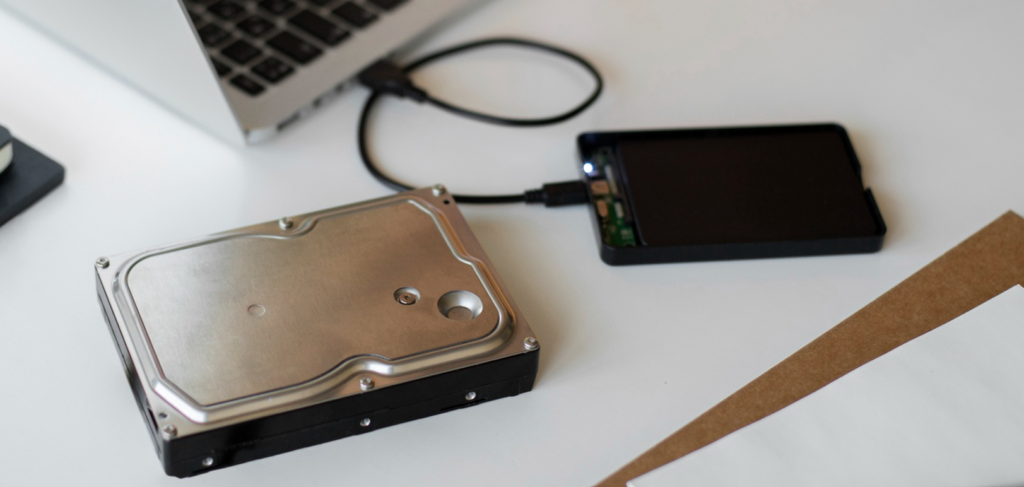
Only huge enterprises willing to make significant investments could afford the 1956 introduction of the first hard drive, which only held a few megabytes and took up a significant amount of physical space. As manufacturing and material advancements allowed storage capacity to increase while physical size drastically decreased, that restriction was gradually lifted.
Tens of terabytes can now be stored on modern drives, a capacity increase so enormous that it is hard to imagine without comparison. Millions of photos, thousands of films, and decades of written labor can now be preserved using a device that’s small enough to fit comfortably in your palm, opening up previously unthinkable possibilities.
Engineers made data storage especially inventive by utilizing sophisticated magnetic recording techniques, which allowed more data to fit in smaller physical spaces without compromising dependability. This development was incredibly successful in guaranteeing that storage will always be strong and surprisingly reasonably priced for both individuals and businesses.
With platters composed of glass or aluminum and covered in layers of magnetic material that are measured in millionths of an inch, the internal construction of a hard drive demonstrates an extraordinarily adaptable fusion of physics and artistry. By changing the magnetic orientation, these surfaces silently retain digital records for many years.
As the platters rotate, air inside the drive circulates constantly, generating mild currents that stabilize the read-write head and maintain extremely effective operations. This unseen movement guarantees seamless operation, preserving the device’s most sensitive parts while enabling remarkably consistent operation.
Cleanrooms that are extremely free of contamination are necessary for the manufacturing of such precise instruments so that assembly can continue without hindrance or danger. Manufacturers were able to attain reliability levels that made hard drives incredibly dependable foundations of contemporary computing by upholding these pristine settings.
When used properly, hard drives exhibit remarkable low cost durability despite their delicate internal balance; many of them continue to function uninterrupted for years. Some have continued to function for decades, keeping data intact even after the nearby computers were forgotten or replaced.
When I watched an ancient drive power on after years of storage, I recall feeling a silent sense of appreciation; the drive’s slight spinning sound suggested resilience rather than aging.
Hard drives continue to be especially advantageous for data centers since they offer massive capacity at prices much lower than those of other technologies, making them indispensable for handling enormous archives. They facilitate study, media streaming, and digital preservation on a never-before-seen scale by hosting enormous information collections.
Additionally, engineers created cutting-edge methods including heat-assisted magnetic recording, which involves momentarily heating tiny regions to increase data density and significantly boost storage capacity. Even though this procedure just took a few seconds, it showed how innovation could lead to completely new performance levels.
Modern drives recover information with highly efficient motion, decreasing delays and boosting total productivity thanks to meticulous actuator arm and positioning system improvement. Reliable performance is ensured even under intense workloads because to this balance between speed and stability.
Hard drives also played a big role in increasing the accessibility of digital storage since declining prices made it possible for anyone to save their own memories without breaking the bank. Important documents, artistic endeavors, and family photos could now be safely kept, enhancing digital independence.
Engineers made sure that information remained incredibly durable by incorporating error-correction algorithms, identifying and fixing errors before they became significant ones. These protections give assurance that data will be preserved even after years of inactivity.
Hard drives continue to provide incredibly dependable performance for businesses handling massive data volumes, enabling uninterrupted, continuous operations. Their capacity, durability, and price are all balanced, which makes them very useful for long-term planning.
Ongoing developments in the upcoming years should result in noticeably higher storage densities, allowing for even more capacity while preserving cost and effectiveness. Engineers are still dedicated to improving recording methods and materials so that hard drives can adapt to new demands.
