

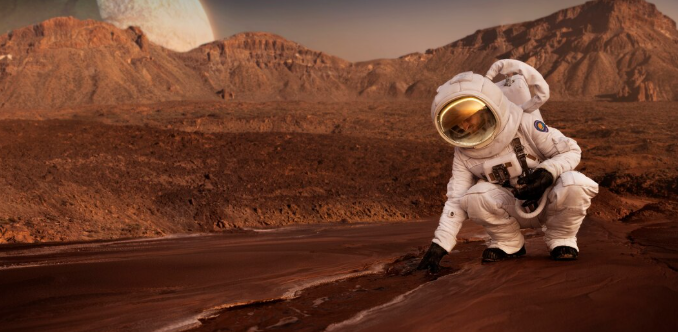
When you see the best images of Mars, the first thing that comes to mind isn’t science. It’s the texture. The floor of a workshop was covered in flour-like dust. As though someone had kicked through a dry creek bed and never returned, pebbles were strewn everywhere. After your eyes have calmed down, the planet begins to play the same old trick of appearing familiar for a brief moment before reminding you that it is not.
In July 2024, NASA’s Perseverance rover encountered a reddish, arrowhead-shaped rock in Jezero Crater. After giving the rock the name “Cheyava Falls,” which sounds almost too homey for the location, it revealed a pattern that has been causing a stir in the scientific community ever since.
| Item | Details |
|---|---|
| Mission | NASA Mars 2020 (Perseverance rover) |
| Location on Mars | Jezero Crater, Bright Angel formation, Neretva Vallis ancient river valley |
| Key rock & sample | “Cheyava Falls” rock; “Sapphire Canyon” drilled core sample (July 2024) |
| What looks “wrong” | Distinct mineral “leopard spot” patterns tied to redox reactions involving organics |
| Why it matters | Potential biosignature—most compelling evidence yet, but not confirmation of life |
| Instruments involved | PIXL and SHERLOC on Perseverance |
| Authentic reference link | NASA press release on the finding: https://www.nasa.gov/news-release/nasa-says-mars-rover-discovered-potential-biosignature-last-year/ |
The pattern is the type of thing that people prefer to ignore until it becomes unavoidable. In high-resolution views, the surface displays small dark specks they dubbed “poppy seeds” sitting next to pale dots surrounded by darker rims, which the team colloquially referred to as “leopard spots.” There is no such thing as a face in the clouds here. Minerals with chemistry that frequently appears in environments influenced by microbial activity on Earth, such as greigite (an iron sulfide) and vivianite (an iron phosphate), were mapped by the rover’s instruments.
In September 2025, NASA took a cautious but telling step by using the term “potential biosignature.” That’s a technical term with a strong human connotation; it may have biological roots, but more proof is required before anyone can use the word “life” without cringing.
This is the section that “should not exist,” at least not in this orderly fashion. The sedimentary material that the rock of Cheyava Falls is situated in, which consists of silts and clays, is precisely the type of fine-grained material that can preserve remnants of ancient microbes on Earth. In the same area, the instruments discovered phosphorus, sulfur, oxidized iron, and organic carbon—a mixture of elements that might have supported microbial metabolisms in the past when water still flowed through this valley.
The “leopard spots” read like reaction fronts in the lab back on Earth, that is, in the brains and laptops of scientists who are looking at data that has been beaming across millions of miles. These are boundaries where chemical change occurred, most likely due to electron-transfer reactions between organic matter and sediment.
Since microbes are blatant opportunists that convert chemistry into calories, life on our planet frequently drives that kind of setup. The team’s own wording on Mars remains consistent: the minerals could have formed without biology, but the non-biological pathways necessitate conditions that the rocks don’t explicitly promote, such as extremely acidic environments or prolonged high temperatures.
It’s difficult to ignore the changes in NASA’s language. Announcements about Mars ten years ago frequently seemed to be a slow march: organics were found, minerals indicated habitability, water once existed—interesting, but always one step away. This time, the agency purposefully backed off after sounding more like a claim. The project scientist reminded everyone of the “extraordinary evidence” in a tone that was equal parts excited and cautious.
The setting of this episode contributes to its intensity. The reason Jezero Crater was selected is that it formerly had a lake and a river delta, the kind of location that turns into a storehouse of preserved history on Earth. With the patient rhythm of fieldwork, perseverance has been drilling, caching, and moving: drive, image, abrade, scan, drill, store. Not a movie. The mission’s emotional climate is then changed by a single rock.
Even though this is the best evidence yet, there is still an awkward, very modern subplot that shows it is a different story. Returning the sample tubes to Earth and performing the types of analyses that no rover can perform on Mars would provide a clear, conclusive response. The “smoking gun,” if there is one, could remain on Mars for years while we quarrel over spreadsheets. However, the Mars Sample Return project has been faltering due to budgetary and cost constraints, and new reports indicate the program has been essentially canceled or is at the very least in serious political trouble.
What, then, does NASA’s data on Mars show “should not exist”? A fingerprint that appears in a location where we are unable to verify it with the instruments that would put an end to the argument, yet which looks strangely familiar in the catalog of life-shaped chemistry. That’s the odd tension: the rover can reveal enough to challenge long-held beliefs, but not enough to give anyone peace of mind.
The universe might be pulling the oldest scientific ruse ever: dangling a pattern that looks like something we know and making us wonder if that is proof or just a clever coincidence. There’s a sense that Mars isn’t yet providing us with an answer as we watch this unfold. It’s issuing us a challenge.
