

Somewhere in a Stanford bioengineering lab is a petri dish. It glows when exposed to ultraviolet light; some cells are red, some are green, and the colors change based on which way a tiny DNA segment is pointing. It sounds almost ornamental. It is not at all like that.
What Jerome Bonnet, Pakpoom Subsoontorn, and Drew Endy have created in that dish has the potential to fundamentally alter how people store information. They have developed a living cell-based data storage medium that can reliably store, erase, and rewrite a binary digit that has been encoded directly into a microorganism’s DNA. three years of labor.
| Field | Details |
|---|---|
| Lead Researcher | Dr. Jerome Bonnet |
| Role at Time of Research | Postdoctoral Scholar, Stanford University |
| Collaborators | Pakpoom Subsoontorn (PhD Student), Drew Endy (Asst. Professor) |
| Institution | Stanford University — Dept. of Bioengineering |
| Device Name | Recombinase Addressable Data (RAD) Module |
| Core Mechanism | Recombinase-mediated DNA inversion using integrase & excisionase proteins |
| Data Capacity (Current) | 1 bit (binary digit); goal is 1 byte (8 bits) |
| Development Time | 3 years, 750 experimental attempts |
| Published In | Proceedings of the National Academy of Sciences (May 21) |
| Key Application Areas | Cancer research, aging, organismal development, environmental monitoring |
| Storage Type Analog | Non-volatile memory (no power needed to retain data) |
“It took us three years and 750 tries to make it work, but we finally did it,” Bonnet remarked with the kind of subdued calm that only comes after years of arduous patience. There were seven hundred and fifty failed attempts before the first one that held.
The apparatus is known as a Recombinase Addressable Data (RAD) module. The fundamental concept is not wholly novel. Recombinases are bacterial enzymes that have long been known to flip DNA segments like a physical switch. Doing it consistently in both directions, repeatedly, inside a living cell was something no one had ever accomplished before.
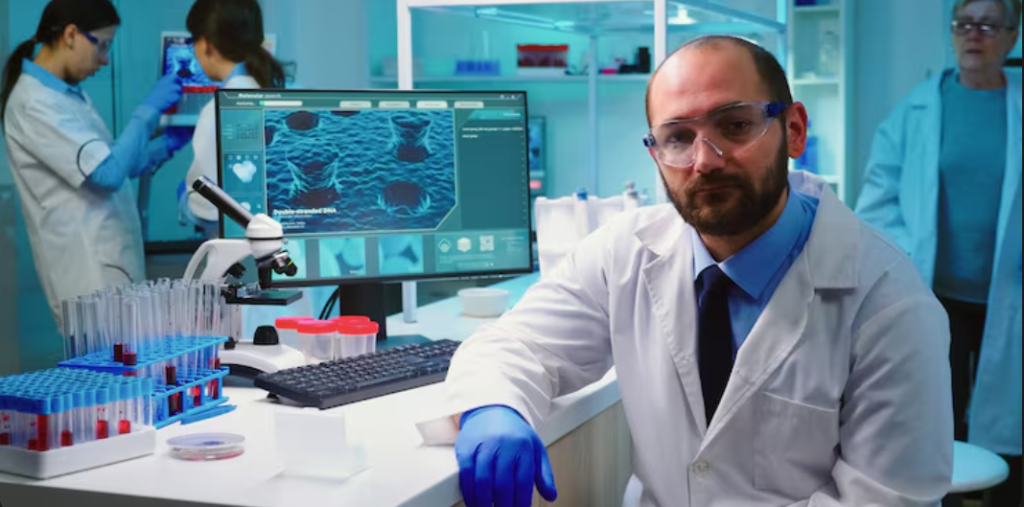
When the segment is flipped one way, it reads zero. It turns into a one when you flip it the other way. Now ingrained in the chemistry of life itself, that is the whole logic of binary computing.
The concept wasn’t the problem. The proteins contained it. Within the same cell, two of them—integrase and excisionase—had to function in precise, balanced opposition. The entire system disintegrated into noise when both were active at the same time or in slightly incorrect concentrations. Random outputs began to be produced by individual cells. Subsoontorn stated, “You get a mess,” with the kind of precision that only comes from witnessing that mess occur hundreds of times.
It’s difficult to ignore the nearly unyielding elegance of what they ultimately achieved. Bonnet examined RAD modules in microorganisms that had undergone more than 100 divisions—cell splitting into cell, generation after generation—and the bit that was stored. After watching the cell divide ninety more times, he flipped the latch and then flipped it back. The data remained intact. It doesn’t require electricity to run. No physical medium will deteriorate over time. Simply biology, doing what biology does, and holding a piece of data in silence.
That type of behavior is referred to as non-volatile memory in traditional computing. The basic idea behind how your flash drive functions is that it keeps data even when it is unplugged. However, a flash drive cannot develop, proliferate, or survive inside a living thing. A cell of bacteria can. It’s a big gap.
The senior researcher on the team, Endy, has a way of discussing this that is both sobering and genuinely fascinating. He believes that location will be just as important to the future of computing as speed and volume. Where does a calculation take place? What is it touching?According to him, “biological systems are one of the coolest places for computing.” Although it’s still unclear exactly what that will mean in practice and when, he is most likely correct.
Although the proposed applications are not science fiction, they are also not yet science fact. Researchers may eventually be able to tell a cell to cease dividing before it develops into cancer if it could count and document its own divisions. Endy is pointing in the direction of reading a cell’s biological history in the same manner that you would retrieve a log file from a server. The concept of a living diagnostic tool operating silently inside the body and taking notes might be the most captivating.
This seems to be at a turning point, much like early transistor research in the 1950s, when the fundamental components of something enormous were still being figured out. At the time, no one knew where it would lead. Going from one bit to eight is Endy’s modest short-term objective.
He thinks that a single byte of programmable genetic data storage could unlock doors that are currently only sketched on the wall. He anticipates that it will take them about ten years to reach that milestone, and he appears content with that timeline in a way that suggests he means it.
The team’s creation is not yet a hard drive. It’s not a server. Currently, it is a single rewritable binary digit that resides inside a single-celled organism in a UV-glowing dish. However, there are many instances in computing history that appeared insignificant at first glance but weren’t. Silently, this could be one of them.
