

A boy was completely stopped by a painting. His mother had hung all of his drawings on the refrigerator with the kind of love that doesn’t require quality. He had been drawing trees, dogs, and anything else his crayon hand could manage for years. One afternoon, he discovered Caravaggio’s “The Calling of Saint Matthew” when he opened a book. The way light penetrates the shadows. Money was strewn, people were frozen at a table, and one man was pointing to himself as if to ask, “Me?” The boy went downstairs that evening, removed all of his drawings, and discarded them. That’s what an artist is, he concluded. Most people who have ever taken art seriously have probably experienced some variation of this tale or something similar. the interaction with something created from a depth of experience that you can sense but cannot fully describe.
Now pose the awkward question: was that painting created by an AI? The chiaroscuro, the composition, and the figures dressed in period attire could all be considered technical variations of it. Midjourney and DALL-E can create images of remarkable technical achievement in a matter of seconds, synthesizing what appears to be art at first glance by drawing from millions of existing works. Frequently, the result is truly lovely. People may be stopped mid-scroll by it. It may inspire awe. However, artists, philosophers, and regular viewers all have a persistent, bothersome feeling that something important is lacking—not in the image itself, but behind it.
| Category | Details |
|---|---|
| Topic | AI-Generated Art — Creativity, Meaning, and the Question of Originality |
| Key AI Tools Referenced | Midjourney, DALL-E, David Cope’s EMI (Experiments in Musical Intelligence), DeepMind’s AlphaGo |
| Historical Precedent | AARON (1970s AI artist); photography once dismissed as “not real art” |
| Key Philosophical Question | Can art created without consciousness, lived experience, or intention be considered a true masterpiece? |
| Notable Quote | Nick Cave — argued AI lyrics in his style were missing the human pain that fuels his songwriting |
| Tolstoy’s Definition | “Art is a human activity… one person consciously conveys to others feelings he has experienced” |
| Relevant Academic Work | Arthur Danto — meaning in art depends on context; Daniel Dennett — “Frankenstein and Spakesheare” thought experiment |
| Key Debate | Mimicry vs. Creativity; Intention vs. Impact; Universal vs. Specific meaning |
| Cultural Milestone | Caravaggio’s “The Calling of Saint Matthew” — cited as an example of art inseparable from human struggle |
| Opposing View | Some philosophers argue meaning is viewer-imposed — if it resonates, origin is irrelevant |
| Reference Links | ThoughtLab — AI and the Masterpiece Debate · Medium — The Human Touch: Why AI Will Never Fully Replace Human Creativity |
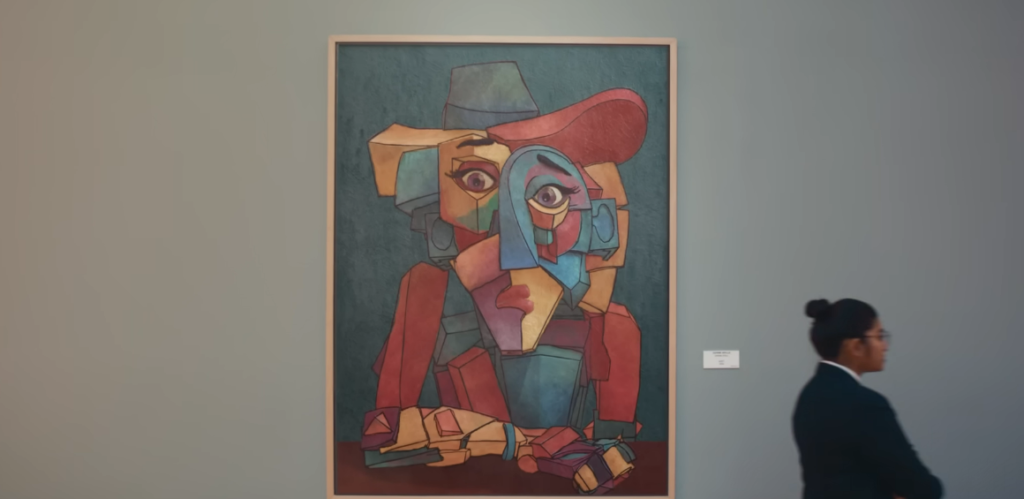
The argument between AI and artistic authenticity has been going on long enough that the opposing viewpoints have solidified into well-known camps. On the one hand, art is defined by how it affects the viewer; if you are moved by a machine-generated image, its source is unimportant. According to this interpretation, meaning is never ingrained by the author but rather imposed by the viewer. Conversely, art is inextricably linked to the artist’s intention, lived experience, and the particular human joy, suffering, or confusion that inspired the creation. When AI-generated lyrics mimicking his style went viral online, Nick Cave made this point quite clearly. The words appeared to be his. He claimed that because they didn’t bear the suffering, his words were truly his own. Even if you don’t agree with Cave’s conclusion, you can still understand his point of view.
Tolstoy, who never shied away from definitions, wrote that art is a human endeavor in which an individual expresses emotions they have truly felt to others, who subsequently experience those emotions themselves. That’s a high bar. Since a machine hasn’t experienced anything in the way Tolstoy intended, it excludes machines almost on purpose. However, it may also leave out a lot of human art, whether it be purely technical, decorative, or commercial. It also brings up a question that is rarely directly addressed in the AI debate: how much of what we refer to as great art was created consciously, and how much was the result of accident, unconscious impulse, or the nervous system acting in a way that the mind had not fully intended? Musicologists were tricked into thinking they were hearing undiscovered Bach by compositions created by David Cope’s EMI program. What specifically was lacking if the experts were unable to distinguish between the two?
It is worthwhile to consider the historical parallels. When photography first appeared in the 19th century, it was thought to be mechanical and incapable of genuine artistic expression. No one now seriously contests that a photograph by Henri Cartier-Bresson or Dorothea Lange is not art. It took decades for the critical establishment to recognize it as a legitimate art form. Then, the question is whether AI is just the next technology to be written off before gaining traction, or if something truly unique is occurring here that cannot be fixed by waiting for society to catch up.
Intention and interiority appear to be the distinction, at least for the time being. A photographer decides what to capture, when to take a picture, and how important the moment is to them. From a human position in the world, that is a human decision. Technically speaking, an AI creating an image is doing something similar—making decisions within constraints—but it has no idea what those decisions mean to it because it doesn’t have any. It doesn’t question the quality of the image. It doesn’t lie awake wondering if it did it correctly. H.R. Giger used his nightmares and the particular texture of fear that came to him while he slept to create art. Giger’s artwork could be used to train an AI to create images that are distinctly Giger-esque. However, the nightmare is not possible. Even though it’s hard to quantify, that gap exists.
Observing this discussion take place in philosophy departments, studios, and online comment sections gives me the impression that we are actually debating something more than software. We are debating whether creativity is an existential or technical ability. Whether the goal of creating something is the final product or the person it transforms. There is no change in machines. They do the processing. The experience changes both the viewer who sobbed in front of the painting and the artist who worked on it for three years. They exchanged something that was lived before it was created. When most people refer to art, they mean that transmission. For now, it’s genuinely unclear whether a machine can ever be a part of it. However, the question itself merits careful consideration because the response will influence our expectations of human artists.
